CONTENTS
- Mesopotamia: The Cradle of Civilization
- Sumerian Fashion: The Origin of Mesopotamian Style
- Akkadian and Babylonian Influence
- Fringe, Gold, and Status
- Hair and Beauty: Crafting the Perfect Look
- Kaunakes and Beyond: The Evolution of Mesopotamian Fashion
- Conclusion: Fashion as a Reflection of Civilization
- References and Additional Links
As human societies shifted from nomadic groups and small farming villages to large, organized urban centers, clothing evolved rapidly. Nowhere is this clearer than in Mesopotamia, often called the “cradle of civilization.” With written records and sophisticated art, Mesopotamia offers us one of the earliest detailed glimpses into how fashion reflected status, identity, and daily life in the ancient world.
Mesopotamia: The Cradle of Civilization

Mesopotamia, meaning “between two rivers” in Greek, was an ancient region located in Southwest Asia, nestled between the Tigris and Euphrates rivers. This fertile land corresponds mainly to modern-day Iraq and parts of Iran, Syria, Kuwait, and Turkey. As the heart of the broader Fertile Crescent, Mesopotamia is often called the “cradle of civilization” due to its early and foundational contributions to human progress, including the invention of writing, the wheel, legal codes, and advanced agricultural practices.
Unlike the more unified ancient civilization of Egypt, Mesopotamia was a region of diverse cultures and empires, including the Sumerians, Akkadians, Babylonians, and Assyrians. Despite their differences, these societies shared a common cuneiform script, a broadly similar pantheon of gods, and overlapping social customs. Mesopotamia’s innovations in city-building, law, and technology laid critical foundations for modern civilization. Beyond these advances, it was also a vibrant center of cultural and artistic expression — especially evident in its rich approaches to clothing and adornment.
Sumerian Fashion: The Origin of Mesopotamian Style
The Sumerian civilization, established before 4000 BCE, was one of the earliest to emerge in Mesopotamia. By 2700 BCE, the Sumerians had already developed a distinctive style centered around the kaunakes — a wraparound skirt originally made from sheepskin, with the wool turned outward and trimmed into decorative tufts. These skirts, worn by both men and women, were pinned at the waist and varied in length: some reached the knees, while others extended to the ankles, often reflecting an individual’s social standing. The upper body was typically left bare or covered with an additional sheepskin cloak for added warmth or modesty.
Around 2500 BCE, woven woolen fabrics began to replace sheepskin, but the tufted, textured look of the kaunakes remained fashionable. This unique style is prominently featured in Sumerian art, including the remarkable artifacts from Ur displayed at the British Museum.
Both men and women loved to adorn themselves with elaborate wigs and stunning gold jewelry encrusted with semiprecious stones. Brooches, earrings, hair ornaments, and layered necklaces were not just accessories — they were powerful statements of personal style and social rank, showcasing the Sumerians’ sophisticated approach to self-expression and craftsmanship.

Akkadian and Babylonian Influence
By around 2370 BCE, a new style emerged in Mesopotamian fashion under the influence of the Akkadian Empire led by Sargon of Akkad. Both men and women began wearing large, draped garments made from wool or linen, often finished with decorative tassels or fringe. These robes were cleverly arranged to allow freedom of movement — for men especially, the right arm was typically left uncovered so they could easily wield weapons or perform ceremonial gestures.
This draped style continued to evolve and flourish under the Babylonians (circa 1900–539 BCE) and the Assyrians (circa 1400–609 BCE), becoming increasingly sophisticated over time. Both cultures favored a layered combination of tunic and shawl. Tunics were usually knee- or ankle-length, with short sleeves and round necklines, while shawls of various sizes and shapes were artfully wrapped on top.
These garments were richly decorated with embroidery and woven geometric motifs, showcasing the region’s advanced textile artistry. Bright, bold colors dominated their wardrobes, and broad belts were used to secure the layered fabrics elegantly in place. Wool remained the primary fabric of choice, but linen grew increasingly popular for its lightness and comfort, particularly among the elite.
Fringe, Gold, and Status
Fashion in Mesopotamia was more than just practical — it embodied status, spirituality, and wealth. The Mesopotamians loved fringe, using it to decorate the edges of garments as a mark of luxury and refinement. Clothing layers and intricate details often signified social rank; the more elaborate and richly adorned one’s attire, the higher their place in society.
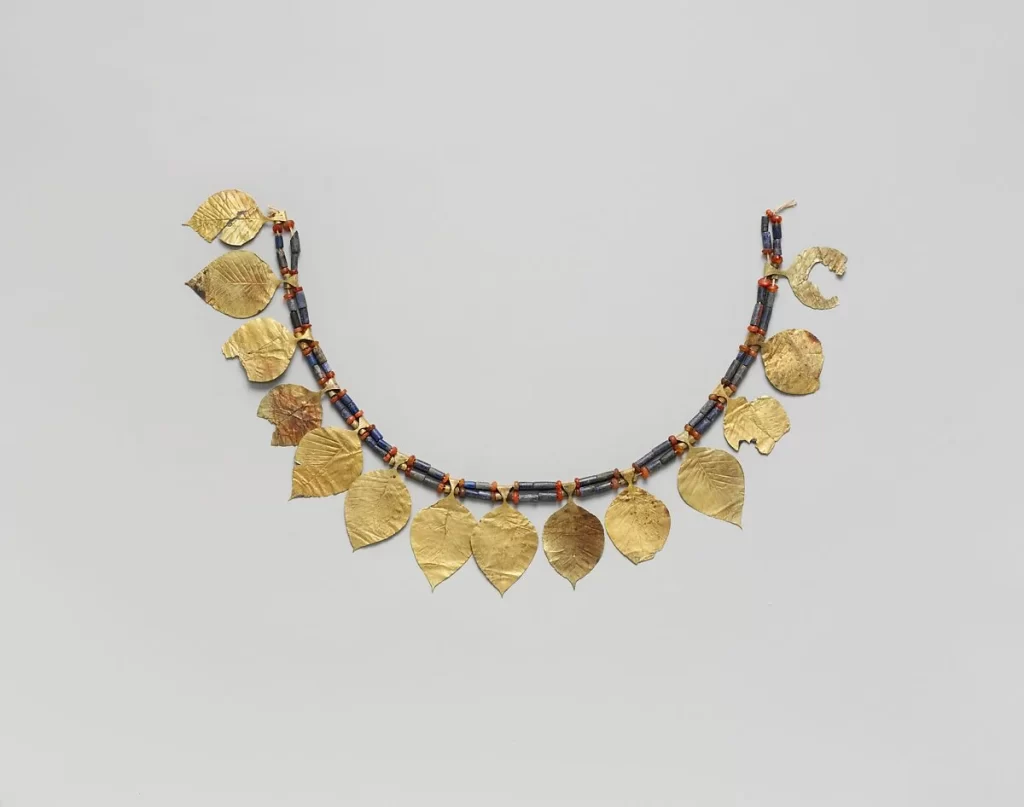
Gold and bronze played crucial roles in Mesopotamian adornment. Headdresses, crowns, and jewelry featured intricate floral motifs, symbolizing fertility and divine favor. One of the most spectacular examples is the burial of Queen Puabi at the Royal Cemetery of Ur (circa 2600 BCE). Her grave goods included an elaborate gold headdress composed of golden leaves, flowers, and ribbons, along with large gold earrings, a massive lunate (crescent-shaped) hair comb, and beaded necklaces made of gold, lapis lazuli, and carnelian. These pieces weren’t just decorations; they demonstrated her elite status and her connection to divine symbolism.
The striking blues and elaborate designs of monumental works like the Ishtar Gate also reflect this culture’s deep appreciation for bold color and ornamentation — an aesthetic echoed in their personal adornments.
Queen Puabi’s elaborate headdress ensemble — including her gold leaf crown, ribbons, and hair ornaments — weighed over 2 kilograms (about 4.5 pounds) in total! She also wore more than 20 pieces of jewelry at once, proving that layering and statement accessories were in style even 4,500 years ago.
Hair and Beauty: Crafting the Perfect Look
Mesopotamian grooming was as meticulous as their clothing. Men often wore long, crinkled beards that were carefully curled and treated with oils, symbolizing wisdom, status, and maturity. Beards were not just fashion statements but powerful symbols of respect and authority. Conversely, shaved heads or closely cropped hair were also common, particularly among priests and temple workers, representing purity or specific social roles.
Women’s hairstyles were equally elaborate, often styled into rounded, voluminous updos reminiscent of some modern high-fashion looks. Sculptures from the Fertile Crescent frequently depict these intricate styles, underscoring the importance of personal appearance. Makeup also played a significant role; powdered pigments, especially dark kohl and mineral-based colors, were used around the eyes to enhance and protect them. Surviving artifacts, such as shells containing cosmetic residues, highlight how integral beauty routines were to daily life.
Kaunakes and Beyond: The Evolution of Mesopotamian Fashion
While kaunakes remained a staple for centuries, Mesopotamian fashion gradually evolved to include more tailored and structured garments. The Assyrians, for example, introduced sleeved tunics and more fitted styles that reflected their militaristic and highly organized society.
Floral motifs, intricate embroidery, and rich, vibrant colors continued to dominate, emphasizing the Mesopotamians’ deep connection to nature and the divine. Clothing in this world was far more than simple protection from the elements — it was a bold statement of identity, a visible mark of social status, and a powerful connection to spiritual beliefs.
Whether through the luxurious fringes of a high priest’s robe or the meticulously curled beard of a nobleman, Mesopotamian fashion tells the story of a civilization that celebrated beauty, craftsmanship, and self-expression in every thread and adornment.
Conclusion: Fashion as a Reflection of Civilization
Mesopotamian clothing and fashion were deeply intertwined with the region’s social structure, religious beliefs, and cultural advancements. From the tufted kaunakes skirts of the Sumerians to the elaborate embroidered shawls of the Babylonians and Assyrians, fashion in Mesopotamia evolved alongside the civilization itself. Their love for color, fringe, and gold reflected not only aesthetic preferences but also symbolized power, status, and divine favor.
Looking back, it’s clear that clothing in Mesopotamia was far more than mere fabric — it was a canvas for artistic expression and a mirror of the society’s values. Just like today, what people wore in ancient Mesopotamia spoke volumes about who they were, what they believed, and how they wanted to be seen by the world.
Leave a Reply